La Cérémonie
From the first frames, Chabrol establishes an expectant atmosphere, with ample payoff in the end. Updating Ruth Rendell’s mid-1960s novel, he deftly shows the different roles that TV plays in the lives of
the cultured and uncultured. Catherine and son diligently tune in to a contemporary film classic but don’t pay the slightest attention
to it, while Huppert and Bonnaire are positively rapt before the crummiest filler the tube has to offer. A
cozy family viewing of a televised opera ends with a literal and figurative bang — slyly implying that by
cloaking itself in high culture, bourgeois society fails to notice even the most blatant indications as to
what the working class is up to.
Performances are on-target across the board, with an intelligently cast ensemble and just the right
amount of tension in the master-servant equation.
Shot in the dead of winter near Saint-Malo, pic favors a bleak, pale, washed-out look. Lensing and
editing carry the story along at just the right pace, with surprises unfolding right up to the closing
credits. Matthieu Chabrol’s slightly melancholy, classically inflected score uses strings to good effect.
Pic’s French title stems from the fact that, in olden days, an execution for a capital crime was referred to
as “the ceremony.”
Lisa Nesselson, Variety (1995)
There's plenty of social criticism implicit in the way the film contrasts these resentful women with the
oblivious bourgeoisie. But Mr. Chabrol is much too astute to draw easy conclusions.
Class tensions fuel the intrigue, but some of these characters are much too peculiar to speak for
anything beyond themselves. There's an extraordinary scene, for instance, in which Sophie and Jeanne
have an impromptu birthday party and trade secrets, exchanging information that would send a more
conventional thriller into overdrive.
Instead, Mr. Chabrol notices how each woman's recognition of the other as a soul mate cancels out any
pangs of conscience. Nothing could be more unsettling than their secret little smiles. And this friendship
is made to seem all the spookier when the women, so intensely drawn together, embrace each other
often but don't bother with sexual love.
Within the sedate realm of the Lelievres, Ms. Bisset glides demurely through the film and still manages
to suggest that the highly unflattering things Jeanne says about her might be true. She and Mr. Cassel
have exactly the right regal assurance to make this story work. So does Ms. Ledoyen, the star of the
recent ''A Single Girl,'' whose very poised, impervious appearance strikes Jeanne as an affront.
There's a little scene in which Jeanne's car has broken down, Melinda stops to help her and Melinda
finds herself holding the grime-stained cloth that she used on the car. How would such a privileged
young woman casually dispose of such a thing? It's a small exchange, but precisely the sort of moment
that Mr. Chabrol can turn quietly devastating. From many such building blocks, ''La Ceremonie'' is
beautifully and wickedly made.
Janet Maslin, The New York Times (1996)
Unease starts building from the opening scene, when a French haute-bourgeois mom (Bisset) hires
aloof, raw-boned, young Sophie (Bonnaire) as a live-in maid for her country home. There's something a
bit odd in the way Sophie interacts with people; polite and articulate, but never initiating conversation,
merely reacting. Other peculiarities surface as she takes over the Lelièvre household. Simple machines,
like dishwashers, seem beyond her ken, and she's both illiterate and incapable of even the simplest
math. These handicaps are artfully concealed from the family, which gladly accepts her quirky manner
as a tradeoff for domestic order. But things start going awry when Sophie forms a passionate friendship
with a cynical, iconoclastic local postmistress named Jeanne (Huppert), whose class-obsessed world
view posits the wealthy Lelièvres as demons incarnate. The friendship is a release for both women, with
troubling secrets and dark urges streaming forth like venom. Under Jeanne's spell, Sophie begins to
rebel against the imagined oppression of the relentlessly decent Lelièvres, first in small ways then in
bold, reckless strokes that lead to a horrific climax which slices home like a shaft of cold, jagged steel in
the belly. Chabrol, whose career has been long and uneven, is back in peak form with La
Cérémonie, which earned six 1995 César (French Oscar equivalent) award nominations, including best
direction, and a best actress award for Huppert. Building tension with a mastery that honors his idol,
Hitchcock, Chabrol slowly parcels out information in a way that deepens, rather than resolves the
mystery. Then, when truth and moral clarity seem hopelessly remote, he brings them home in a
breathtaking rush that sends you home chilled but exhilarated. With its deliberate pace and somewhat
clinical view of its characters, La Cérémonie is hardly classic summer movie fare. But for those who are
susceptible to its hypnotic allure, it could rank among the season's best.
Russell Smith, Austin Chronicle (1997)

The plot of The Ceremony is fairly simple, but it’s also full of ambiguity–something that corresponds at
times to the elegant mise en scene. The very first shot, for example, follows Sophie Bonhomme
(Sandrine Bonnaire) as she crosses the street toward the camera, turns to the left, enters a cafe, and is
greeted by Catherine Lelievre (Jacqueline Bisset), who calls her over. It’s a shot lasting over half a
minute, and something of a tour de force, because it involves several camera movements and a
continuity between exterior and interior lighting. What makes it ambiguous is that it seems like an
objective shot filmed from the approximate vantage point of Catherine, who’s sitting inside the cafe
watching Sophie approach through the plate-glass window. It isn’t until the shot is more than half over
that we glimpse Catherine in the foreground and realize that what we’re seeing is subjective.
The standard critical line about Chabrol is that he’s a Hitchcockian, with a mise en scene periodically
grounded in subjective camera angles. I can’t deny this facet of his work, but an equally important
influence, by Chabrol’s own testimony, is Fritz Lang, whose hallmark as a filmmaker is a certain abstract
objectivity, and it is in the play between Hitchcock’s subjectivity and Lang’s objectivity that Chabrol’s
best work usually takes shape.
Just as the first shot in the film is a Hitchcock shot that begins by masquerading as a Lang shot, there’s
an apparently Langian continuity cut that introduces the second encounter between Catherine and
Sophie–a cut from a line of dialogue stating that Sophie will be arriving on the train at 9 AM to Catherine
on the train platform at 9 AM, looking for Sophie without finding her. But then comes a subjective pan
following Catherine’s gaze as she spots Sophie on the other side of the tracks–an eerie play on
expectations that qualifies as Hitchcockian.
The Ceremony marks an important shift in Chabrol’s view of the bourgeoisie; for the first time he seems
to like his bourgeois characters without irony or sarcasm: they’re a sweet bunch of people. Yet most of
The Ceremony is seen from the vantage point of Sophie and her best friend, Jeanne (Isabelle Huppert), a
postal worker whose hatred for the Lelievre family grows to such unreasonable proportions that
anything becomes possible. The brilliance of Chabrol’s movie rests precisely in this dialectical
ambivalence: one feels throughout that he has nothing but affection for the Lelievres, yet he also
understands deeply the murderous class hatred of Sophie and Jeanne and precisely how it develops.
Like the ambiguous shifts between a Hitchcockian and a Langian approach, this ambivalence gives
Chabrol’s thriller most of its tension and edge. Significantly, his cowriter–Caroline Eliacheff, the wife of
Marin Karmitz, the producer–is a psychoanalyst, and in interviews Chabrol credits her for developing the
psychology and psychopathology of both these women beyond the elements found in the novel.
Jonathan Rosenbaum, Chicago Reader (1997)
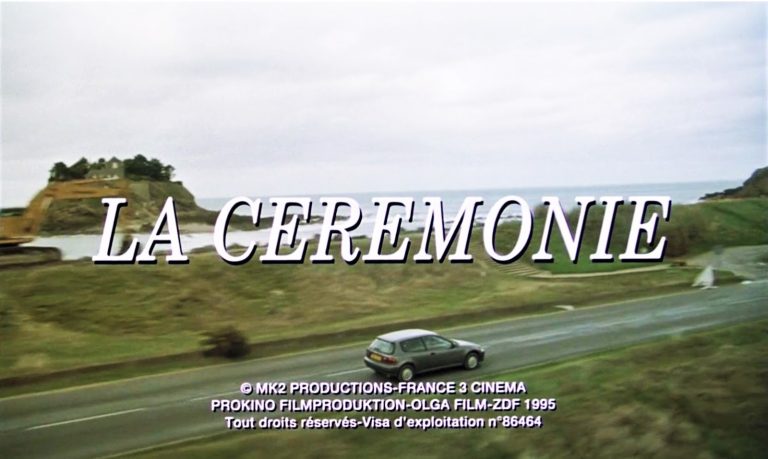
Claude Chabrol explores the themes of isolation and loneliness in La Cérémonie. The film’s opening
credits roll against the landscape shot of Madame Lelievre’s car traversing the empty road leading to the
remote estate. In essence, the geographic location is a reflection of Sophie’s alienation from the Lelievre
family, as she attempts to keep her illiteracy a secret. Sophie’s long walks to town and her affinity for
watching television serve, not as pleasant diversions from the emptiness and boredom of the house, but
as a means of distraction and evasion. Her relationship with the disreputable Jeanne stems from a
mutual sense of maladjustment and disaffection. La Cérémonie is an elegant, haunting, and tragic tale of
a woman driven by personal insecurity down a path of destruction and despair. It is the road to ruin.
Acquarello, Strictly Film School (2000)
The film’s undermining of conventional social dynamics is subtly inscribed in its mise en scène. As a
perceptive review in Les cahiers noted, Sophie’s second appearance bears a hint of the unexpected: as
the wife Catherine comes to meet her at the train station, Sophie is already waiting on a separate
platform. Her being placed (initially) outide of the frame suggests omniscience: she’s free to see all, yet
remain unseen. Within the formal set-up of this scene, she implicitly has the upper hand over her
employer, which foreshadows the genuine reversal of power she will eventually exercise over Catherine
and her family.
More interestingly, Chabrol presents certain gestures and actions in a rigorously mannered form,
making them seem ritualistic. As the relationship between Jeanne and Sophie grows increasingly
intimate, he shows them at one point seated arm-in-arm. Although they are sharing affection, in their
composure Sophie and Jeanne appear mechanical, as if their actions are the playing out some larger
scheme.
Julien Lapointe, Senses of Cinema (2001)
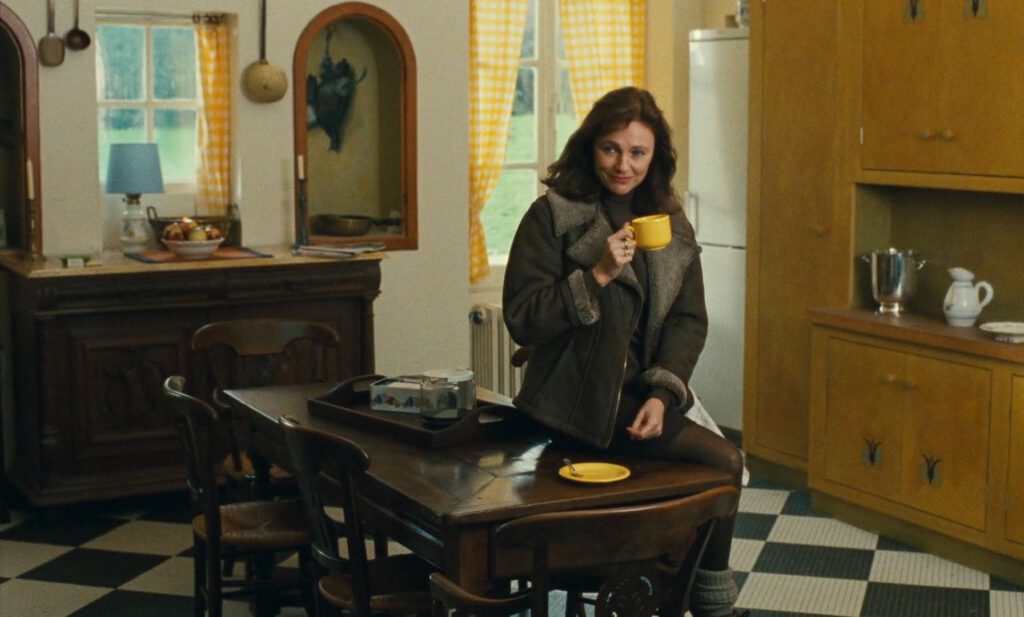
Chabrol doesn't paint the Lelievres as callous or abusive to create his conflict. They're a loving family
who care about each other and don't wish to exploit anyone. Because Sophie is so dedicated and
efficient, Georges and Catherine never question her uncommunicative nature. The Lelievres are
targeted simply for what they are: The wealthy, the employers, they who make the rules.
By the time Catherine's charming daughter Melinda (Virginie Ledoyen) has discovered Sophie's secret it
is too late. The maid and the postal clerk have already melded into a dangerous pair, feeding off
Jeanne's mounting feud with Georges Lelievre. Once the women exchange secrets about their violent
pasts, they become confederates in a fatal conspiracy, a relationship that moves from dull normality to
appalling violence. For them, the killing spree is a joyful liberation from the bonds of a classed society.
Claude Chabrol once again shows himself a superior director of actresses. His frequent collaborator
Isabelle Huppert plays a selfish and petty troublemaker, while Jacqueline Bisset's portrait of a charming
country wife is flawless. The prize characterization is Sandrine Bonnaire's emotionally stunted,
guardedly perfectionist Sophie. Her excellent work habits disguise a void where judgment and self-
restraint should be. The key scene is when the friendly Melinda inadvertently discovers her maid's
secret handicap: Sophie's immediate, threatening response is chilling. This harmless-looking woman is
capable of anything.
Glenn Erickson, DVD Savant (2004)
A smart, fashionable, well-heeled French family living in a gorgeous country house are looking for a new
housekeeper. The lady of the house, (wonderfully) played by Jacqueline Bisset, hires an enigmatic, quiet,
but apparently highly efficient young woman, Sophie (Sandrine Bonnaire). Everyone is happy with her:
she cleans, she cooks, she doesn't type (but that's another, but relevant, matter). Wandering into the
village, Bonnaire meets the outspoken, feisty, village postmistress, energetically played by Isabelle
Huppert. They become bosom buddies and will soon run the show. At gun point. The film is a gem.
Superbly acted by Huppert and Bonnaire (you understand why the Venice jury deemed their
performances "inseparable"), but also by Bisset, Jean-Pierre Cassel, Virginie Ledoyen and Valentin
Merlet, it is deceptively simple, but in fact as diabolically twisted, psychologically, as actioner "The Usual
Suspects". Set to Mozart's "Don Giovanni", the transformation of Huppert and Bonnaire into Bonnie and
Bonnie is both horrifying and hilarious. You don't know whether you want to laugh or choke, but you
sure know you want to applaud. Don't miss it when it comes out.
Henri Béhar, Film Scouts (2004)
Unlike many Hollywood films La Ceremonie is more interested in character development and less in the
actions of the crime. One thing that's notable too is that Chabrol doesn't have a sarcastic eye on the
bourgeous family like he often does. Neither is he critical of the two women. He keeps an objective
distance without moralizing the actions of anyone. But, for me, what makes the film great is the tension
that builds and the true anarchic madness that comes to the surface in the film's final scenes. It's
deliciously vicious.
Matt Langdon, DVD Talk (2004)
Apart from the predilection for thrillers he shares with such like-minded directors as Hitchcock and
DePalma, Chabrol also often takes as his subject the relationship between the working class and the
bourgeoisie. The class struggle is never the primary focus of his films, however, but it often informs the
dynamics of the story or provides the catalyst for the action. It is also often expressed in ways other
than the simple exchange of capital or the exercise of power that goes along with it. In the case of La
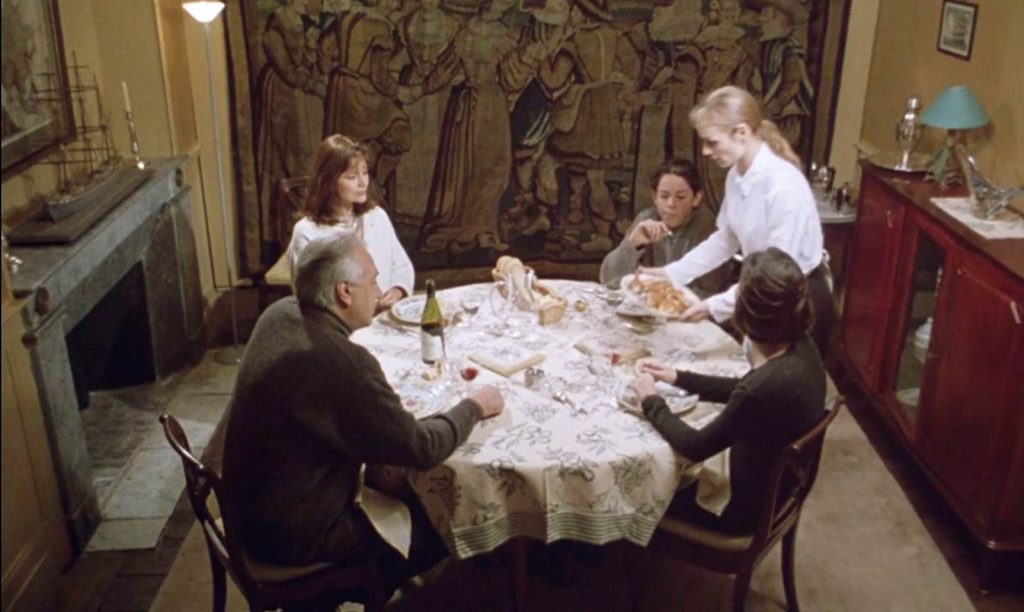
Cérémonie, the difference between the classes is demarcated by the choice of each in what they watch
on television. In Chabrol’s film, the wealthy (when they watch television at all) watch art films or operas.
The working class, exemplified in the film by Sophie, watch “junk” television—game shows, music
videos, comedies—and they watch it incessantly. Television plays a central role in the dénouement of
the film and the ubiquity of it in Sophie’s life may help to explain the feelings of abject isolation and
alienation she feels as, essentially, a paid prisoner in the Lelièvres’ massive house.
Matt Bailey, NotComing.com (2005)
La Cérémonie, arguably Chabrol and Huppert’s finest joint effort, matches Huppert with Sandrine
Bonnaire as a disgruntled postal clerk and sinister housekeeper, respectively, against which the self-satisfied, opera-loving family of Jacqueline Bisset hasn’t a ghost of a chance. Scheming in her little post
office, Huppert’s Jeanne, a nasty piece of work, snarls at Bisset and her gentlefolk, the same class-
warfare snarl we saw in Story of Women, or indeed in any number of Huppert films in which a trapped
woman lashes out at her tormentors. It’s an archetypal image, the face in the front row of the public
execution, the face of the collabo, or of the mother who inexplicably drowns her children.
Kelly Vance, East Bay Express (2006)
Chabrol is at home in the world of the wealthy, and does an effortless job of showing the Lelievre family,
confident, affectionate, dining in style, appreciating fine wines, lining themselves up all four on a sofa to
watch an opera by Mozart on TV. This is a contrast to the two young working-class women upstairs,
whose relationship and the TV they watch is attuned to Sophie’s simplistic mind. Assuming Jeanne is
much smarter than Sophie, what we see taking shape is an act of resentful violence, in which the
childlike maid is the murder weapon. The film implacably moves toward a horrifying conclusion.
Roger Ebert, RogerEbert.com (2012)
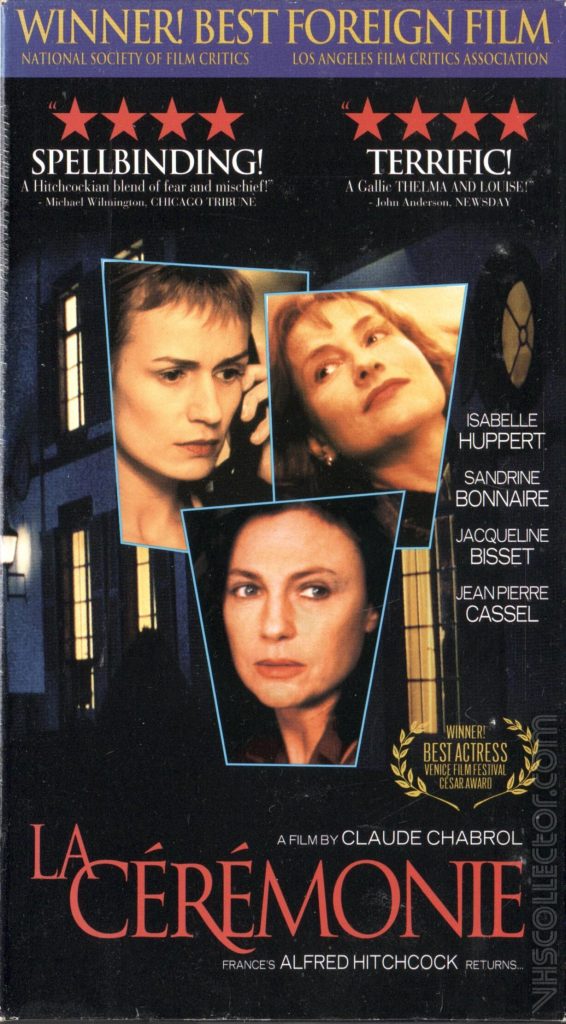
Some may view the movie as an attack on the bourgeoisie, as represented by the family Bonnaire works
for. But Chabrol, though he has described the film as the "last Marxist movie", retains some balance.
True, the Lelievres are rich and live in luxury. At the climax, the family watch Don Giovanni on television,
wearing evening dress. However, even here, it is hard to gauge from their high-flown dialogue ("It's very
homogenous: nobody stands out," Mme L says of the performance), whether we are supposed to see
them as pretentious or cultured. Certainly, they are considerate employers, even if Jacqueline Bisset's
superb mistress of the house is too chic-ly busy to notice much that goes on around her. If the movie has
a message, it's that the fault lies not in masters or serfs, but in the society that fosters such divisions.
The rich's succour only exacerbates the wounds of the poor. Then again, you may think the movie
illustrates the problem of getting good staff these days.
Quentin Curtis, Independent on Sunday (2017)
Something telling, something vital to the film, happens in La Cérémonie’s first few seconds. But it’s the
kind of fleeting moment that doesn’t register, and can’t register, until the film is over. By then it will
probably have been forgotten.
A woman (Sandrine Bonnaire), a tiny figure seen in long shot, stops in front of a bar, looks at the door,
and turn to ask a passerby for directions. He points across the street. The woman proceeds in that
direction and enters a café, where another woman (Jacqueline Bisset) is waiting for her. We’ve been
watching this scene from inside the café, from the second woman’s point of view. Our point of view is
hers. It’s a viewpoint La Cérémonie will come to indict. But that’s not the telling detail.
The woman in the café is Catherine Lelièvre, a bourgeois housewife and art-gallery owner waiting to
interview Sophie Bonhomme for the position of housekeeper. Catherine is friendly, Sophie all business,
but the two women, dressed professionally, seem on equal footing. The plot of this thriller hinges on the
consequences of Sophie’s illiteracy. She had to ask directions because she couldn’t read the signs: she
couldn’t tell the bar from the café.
Chabrol undermines the concept of “the reveal” by getting it out of the way before he does anything
else. It’s the first sneaky move in a subtly radical film.
A.S. Hamrah, n+1 (2018)
Chabrol succeeds in showing the anger these two have inside them and how it is possible in their
relationship for this anger to become deadly. He indicates that if left to themselves it is unlikely that
their anger would have been manifested in such a deadly manner.
We never get to know Sophie. She says as little as possible, even to her friend. We never get her to
admit that she killed her father. All we know, for sure, is that she is illiterate and is capable of destroying
things and of lying.
The film concludes with a bloodbath. We read about unusual crimes like this in the tabloids, and we
have knee-jerk reactions toward the criminals based on our pre-conceived beliefs. Chabrol pokes fun at
the upper-class but is still able to show that it is not entirely their fault that the underprivileged can’t
rise. The family is joyfully listening to the opera Don Giovanni just before they are accosted by the two
female losers. The only enjoyment we have seen from the two women comes from either their ironing
or snooping. The destruction of the family that follows is shocking and brutal, it is symbolically an attack
on Western civilization.
Chabrol’s camera work magnificently shows the tension and movement toward violence long before it
happens. The acting is top-notch, the mannered performances of the family was terrific, and the
exorcism of bourgeois complacency is delivered with force.
Dennis Schwartz, Dennis Schwartz Movie Reviews (2019)
In the last year we’ve seen quite a few films about financial disparities and the trend of “eat the rich.” La
Cérémonie is and isn’t that, for its revenge and stature feel foreseen and yet impulsive. The casualness in
which the eventual carnage is cast is disquieting. Claude Chabrol exudes a confidence in the direction
and the excellence in acting carries the picture.
It’s a tense and unnerving film that seethes with an unabashedly chilling timbre. Throughout its runtime
I felt the uneasiness but it’s presented in such a peculiar way that there were surprises to be found in
the rare details. It doesn’t shy from these characters unusual nature or their inner demons. Yet, I
couldn’t stop watching.
Stealthily clever, La Cérémonie revels in its peculiarity with a sharp edge. This was a hell of a gem, I
won’t soon forget.
Kristy Strouse, Cinematic Lovelies (2023)
La Cérémonie is the kind of thriller you can watch repeatedly and glean new insight from each time.
Right from its first scene, there’s something puzzling about the buttoned-up Sophie (Sandrine Bonnaire)
that narrows your focus and pulls you in. What’s remarkable is that, even after the secret Sophie's
keeping that seems to explain her strangeness is revealed, our intrigue never dips. Director Claude
Chabrol and his cast construct a gripping twin character study and biting social commentary around that
initial hook, as Sophie finds a kindred spirit in the equally uncanny Jeanne (Isabelle Huppert), who opens
her eyes to the slyly patronizing way Sophie’s employers treat her. The film’s study of class relations is
always subtle, never veering into over-pronounced territory. That much is clear from the fact that,
although some of Sophie’s employer’s family are quite likable, you still understand the ways they’re
inextricably embroiled in the film’s quiet indictment of the power dynamics that rule this lofty mansion.
More nuance comes by way of the strikingly nonchalant ways evil is depicted in La Cérémonie — just
another example of the movie turning something expected (violence is foreshadowed early on) into
something that remains viscerally shocking, no matter how many times you watch it.
Farah Cheded, A Good Movie to Watch (2023)