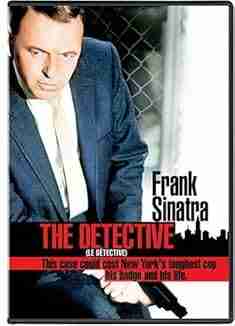
The Detective
New York City police detective Joe Leland is called to the home of a murder victim. The police on call are left bemused, and Leland holds things together with his direct, no-nonsense approach.
Few leads are found, other than the fact that a housemate of the victim remains conspicuous by his absence. All the while notions about the victim’s sexuality and personal interests warp the ideals of the officers assigned to the task. Leland tries to remain focused on the case while dealing with the breakdown of his marriage to wife Karen.
Eventually, the victim’s housemate is identified as Felix Tesla, and he is soon tracked down by Leland and another detective. Leland makes a psychologically disturbed Tesla crack and coaxes a confession out of him. This results in extensive publicity, a promotion for Leland, and the death of Tesla, which distresses Leland. It is clear to him that Tesla is insane.
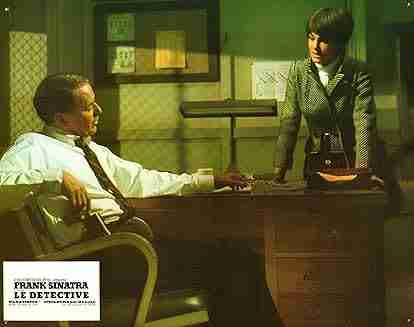
Later, across town, a man kills himself by jumping from the rooftop of a racetrack. The case goes unnoticed until the much-younger wife of the dead man, Norma MacIver, comes to Leland’s office and asks him to investigate, believing something far more complex is involved.
Leland and partner Dave Schoenstein question various leads. A psychiatrist, Dr. Roberts, clearly knows more about the dead man, Colin MacIver, than he is willing to reveal. The therapist also is familiar with Karen Leland, whose infidelity is putting a great strain on the detective’s home life and distracting him from his work.
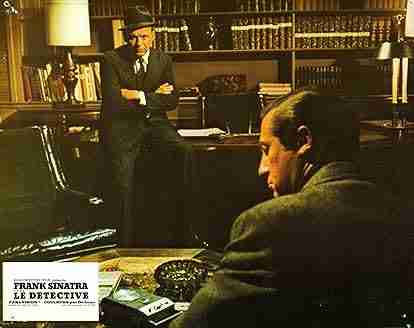
MacIver made a taped confession to Dr. Roberts in which he also explains that he used the doctor’s name as a front in his real estate scheme. Roberts insists that Leland keep MacIver’s confession secret to preserve the detective’s professional reputation as well as the powerful interests who do not want their crimes exposed. The film ends after Leland has revealed the truth and is happy to let the chips fall where they may.
Leland soon learns that certain powerful interests in the city do not want him to ask questions about their scheme to inflate the value of real estate. Leland discovers MacIver is at the center of the scheme. The incorruptible detective presses on, at risk to his career and life, as he discovers an unconventional relationship between the man’s suicide and the previous murder.
Sinatra is always an interesting actor, and in “Tony Rome” and “The Detective” he has mellowed into a genuinely convincing cop. He is weary and wise and tough and cynical in the way Bogart used to be, and indeed he is probably better at these hard-boiled roles than anyone since Bogart died… It is pretty clear that Sinatra wanted “The Detective” to be as good a movie as he could manage. It provides a clear, unsentimental look at a police investigation, and even the language reflects the way cops (and the rest of us) talk.
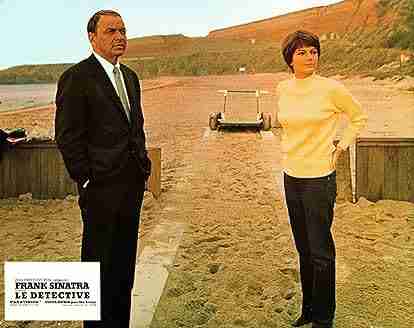
"THE DETECTIVE" is the kind of film in which Frank Sinatra, as a New York law officer of high principles, drives 40 miles or so out of Manhattan and arrives at a beach house that must—from the looks of the landscape — be in Malibu, Calif. This casual handling of geography epitomizes a film that haphazardly, even arrogantly, mixes the real and the fake. …Perhaps the nicest thing that can be said about "The Detective" is that it is a film of transition. It deals with subject matter available to the new Hollywood in a style that reflects the old.
Unwisely, the film was shot in color. A shadowy, frightening city like New York has its essential grittiness softened by the sweetness of color. Here is a thought to toy with-if this is what the New York Police, supposedly America's best, are like, then what manner of monster is patrolling the streets, in the name of the law, in all the other cities?
As part of the continuing trend of neo-noir films that examines darker, more controversial, and more taboo themes throughout the ‘60s, “The Detective” paves the way for the perfection of something like “The French Connection.” This one has a harsher edge to it than the adventures of Tony Rome, giving it a decided advantage over not only the other two Douglas/Sinatra entries but also its coeval peers (even across the ‘70s) … And though the music has a lighter tone than it should, the action and violence surrounding the wealth of unethical personas are entirely fitting for this type of heavy-hitting dive into neo-noir.
Both The Detective and Rosemary’s Baby went on to be big box office hits, though the former has largely been forgotten while Polanski’s picture became a classic. Yet in its own way The Detective is just as iconic, and certainly more influential. It serves as a bridge between older cop movies like Detective Story and the more modern style about to explode in the form of films such as Bullitt and Dirty Harry, and establishes many of the conventions that would define crime films for the next several decades. Indirectly, the novel also kick-started the preeminent action style of the late 80s and 90s, since its sequel, Nothing Lasts Forever, would ultimately be adapted (extraordinarily loosely) into Die Hard. There’s little similarity, however, between the tortured, self-reflective detective played by Sinatra in director Gordon Douglas’s 1968 noir and the amiable everyman made famous by Bruce Willis in the unofficial sequel; just as Die Hard is a product of its time, The Detective is a dark, morally complex and challenging work that feels right at home alongside Bonnie and Clyde and The Wild Bunch. If it is not quite as singular as those two films, it is still a remarkable piece of classical studio filmmaking merged with the edgier sociopolitical attitudes that were about to obliterate that studio system.
But The Detective is about mood and disappointment. And at the center of it all is Ol’ Blue Eyes himself. Morose and reflective, Sinatra is the calm eye of the storm. Having long before abandoned the aw-shucks persona that propelled him through an early career of Hollywood musicals and comedies, Sinatra embodies a perpetual melancholy teetering dangerously near the brink of depression. Rarely have the lines on his face seemed more deeply etched, rarely have his eyes seemed so sad, so drained of hope and vivacity.
Screenwriter Abby Mann, known for his famed collaborations with Stanley Kramer, brings his interests in social issues to a very topical problem. In his passing deliberations on the film, Vito Russo quotes Mann’s statement to the New York Times in 1967 about how society is more apt to accept a murderer’s actions over one’s professed homosexuality, which is what The Detective aims to enlighten us on from its very first frame.
The Detective belongs to its writer, Abby Mann, and he has made it into the kind of "tough," "hard-hitting," "socially conscious" picture that Hollywood used to pride itself on.
The Detective, an adaptation of the 1966 novel by Roderick Thorp, casts Sinatra as Joe Leland, an NYC cop who comes to the realization that two of his cases are inextricably bound. Some of the content involving homosexuality now seems dated — …but as a police procedural, it is a worthwhile watch. …In 1979, Thorp penned Nothing Lasts Forever, a follow-up novel also featuring the character of Joe Leland. For the 1988 film version, the character’s name was changed to John McClane, the role was played by Bruce Willis (Sinatra had turned it down in a previous incarnation), the movie was titled Die Hard, and the rest is cinematic history.